

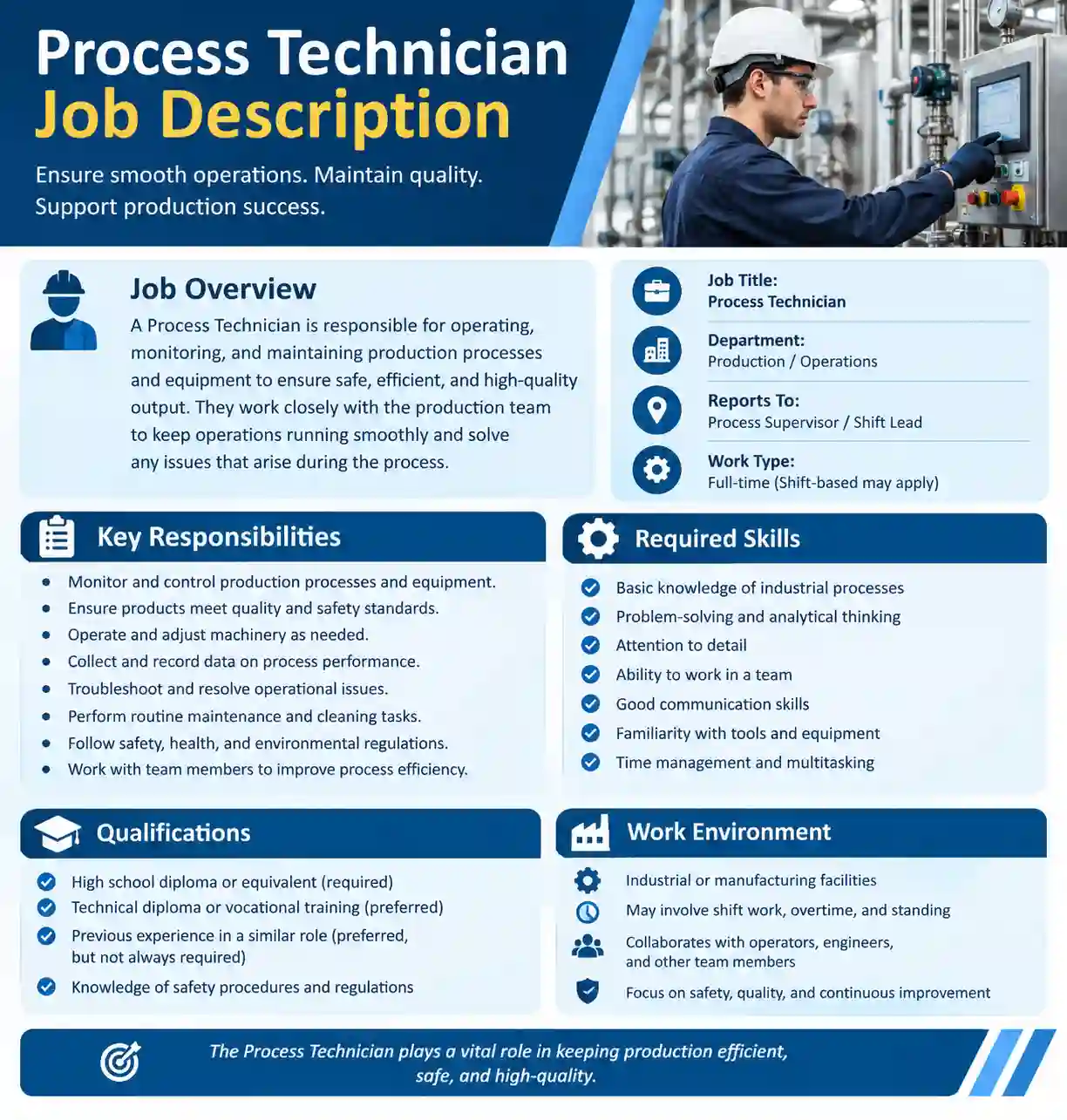
Quick answer: A process technician runs, checks, and fixes the machines and systems that make a product. They watch the process, take samples, record data, fix small problems, and follow safety rules. They work in places like factories, chemical plants, oil and gas sites, drug-making companies, food plants, and computer chip makers.
This guide is for job seekers, students, and hiring managers. You will find a plain-English job description, a list of duties, skills, and qualifications, pay facts, resume and interview tips, and a copy-and-paste job description template.
What Is a Process Technician?
A process technician is a worker who looks after a step in a making process. Think of a factory line that turns raw things into a finished product. The process technician sets up the equipment, keeps it running, watches the numbers, and makes sure the product is made the right way and stays safe.
They need to know their part of the process in great detail. When something goes wrong, they find the cause and fix it, or they call the right person for help.
Process Technician Job Description

Job summary: The process technician runs and cares for the equipment in a production area. This person watches the process, finds and fixes problems, keeps records, and follows all safety and quality rules. The goal is to keep production safe, steady, and on time.
This is a general job description. The exact work changes from one industry to another.
Main Duties and Responsibilities
Here are the most common duties of a process technician.
- Set up, start, run, and shut down production machines and systems.
- Watch dials, screens, and alarms to make sure the process stays in the right range.
- Take samples and test them to check that the product meets the rules.
- Read gauges and write down data in a logbook or a computer system.
- Find and fix small equipment problems to reduce downtime.
- Do root cause analysis, which means finding the true reason for a problem, so it does not happen again.
- Do routine cleaning, checks, and simple maintenance.
- Report faults, delays, and safety problems to a supervisor.
- Follow standard operating procedures, called SOPs, and keep them up to date.
- Work with engineers, operators, and maintenance teams to improve the process.
- Help cut waste, defects, and costs.
- Follow safety rules, wear the right safety gear, and report hazards.
- Keep the work area clean and tidy.
- Train new team members when asked.
Many sites also ask process technicians to do a few extra tasks.
- Review and adjust machine settings, called parameters, to keep the product in range.
- Use simple statistics tools, such as control charts, to study process data and spot problems early.
- Keep track of supplies and materials, and tell the team when stock is low.
- Give technical support to projects, such as new product trials and small process changes.
- Help cut waste and costs by finding small ways to save time and materials.
Budgets and labor plans are usually handled by supervisors or engineers, but a technician’s data helps them make good choices.
Skills a Process Technician Needs
Technical Skills
- Reading and understanding process diagrams and equipment manuals
- Running and monitoring machines and control systems
- Basic math and measurement skills
- Troubleshooting and problem solving
- Basic computer skills for data entry and monitoring screens
- Knowledge of quality checks, such as taking samples and reading results
- Basic maintenance and repair skills
- Knowledge of safety rules, such as lockout and tagout
Soft Skills
- Good attention to detail
- Clear communication with the team
- Team work
- Staying calm when something goes wrong
- Being on time and dependable
- Willingness to learn new systems
- Good record-keeping habits
Two other skills matter a lot. Good observation skills help you notice small changes, like a strange sound or a reading that moves a little. Critical thinking helps you ask why a problem happened and pick the best fix.
Qualifications and Education

Most employers ask for the following.
- A high school diploma or equivalent. This is the usual minimum.
- An associate degree or certificate in process technology, industrial technology, chemistry, or a related field. This is often preferred, and it can help you start at a higher level.
- Short training in safety, such as basic workplace safety.
- Some jobs ask for experience in manufacturing, a lab, or a plant.
- For regulated work, such as making medicine, extra training may be needed.
Helpful extras include a certificate in lean or Six Sigma, which are ways to cut waste and improve quality, and any hands-on experience with machines or process control systems.
Classes in math, science, and drafting are a big help. It also helps to learn basic computer-aided design and computer-aided manufacturing software, called CAD and CAM. You can study at a community college, a technical institute, or a vocational school, and many of them offer short certificate programs.
Most technician jobs do not need a four-year degree. Some jobs that support engineers ask for a bachelor’s degree, such as one in mechanical engineering, but this is not needed for most process technician roles. Check each job post to see what is really required.
Helpful Certifications
Certifications are not always required, but they can help you stand out. Check what your employer accepts.
- A process technology certificate or degree
- Basic workplace safety training, such as an OSHA safety course
- Lean or Six Sigma training, to learn how to cut waste and improve quality
- Good Manufacturing Practice training, called GMP, for medicine, food, and other clean industries
- Lockout and tagout training, which teaches how to shut down machines safely
- Forklift or equipment training, if the site uses it
Working Conditions
Process technicians often work in plants and production areas. The work can be loud, hot, cold, or messy, and it may need protective gear. Many sites run all day and night, so shifts can include nights, weekends, and holidays. Some jobs require standing for a long time, lifting, or climbing. Safety rules are strict, because the work may involve chemicals, high heat, or heavy equipment.
The job also asks for good body and mind stamina. You may work long hours, stand for a long time, or work in hot, cold, or wet places, and even outdoors in some plants. Staying focused for a whole shift matters, because a small mistake can cause a big problem.
Process Technician Salary
Pay depends on the industry, the place, the shift, and your experience. Jobs in oil and gas, chemicals, medicine, and computer chips often pay more than basic production jobs. Night shifts and overtime can add to your pay. In the United States, many process technicians earn from the mid-forties to over eighty thousand dollars a year. Because pay changes often, check a current job site or a government labor report for your area.
Pay by Industry
The industry you work in changes your pay a lot. These are general patterns, and exact numbers change by place and year.
- Oil and gas and chemicals: Often among the higher-paying areas, with extra pay for night shifts and hard conditions.
- Semiconductor: Often good pay, and sometimes extra pay for shifts and clean-room work.
- Medicine and biotech: Pay can be strong, and it often goes up with training and GMP experience.
- Food, plastics, and general manufacturing: Often a little lower at the start, but with steady work and room to grow.
Shift pay, overtime, and bonuses can add a lot to your yearly total, so look at the whole offer and not only the hourly rate. You can also ask whether the company pays for training.
Types of Process Technician Jobs
The job name stays the same, but the work changes by industry.
- Chemical process technician: Runs chemical reactors, mixers, and tanks, and checks that the mix is safe and correct.
- Manufacturing process technician: Runs and improves machines on a production line.
- Injection molding process technician: Sets up and watches machines that melt plastic and press it into shapes.
- Plastic process technician: Works on plastic products, often with heat, molds, and cooling systems.
- SMT process technician: Works with surface mount technology, the machines that place tiny parts on electronic boards.
- Semiconductor process technician: Runs equipment used to make computer chips in very clean rooms.
- Pharmaceutical and biotech process technician: Makes medicines and vaccines, following very strict clean and record rules.
- Oil, gas, and refinery process technician: Watches pumps, pipes, and units in a plant that handles fuel.
- Food process technician: Runs food-making lines and keeps food safe.
- Electric car and battery process technician: Works on battery and vehicle production lines.
- Water and power process technician: Runs systems that clean water or make power.
Industry Duties in More Detail

Chemical Process Technician
A chemical process technician runs tanks, mixers, and reactors. They watch temperature, pressure, and flow, take samples, and read safety data sheets, which list the dangers of each chemical. They also follow strict rules for handling and storing chemicals.
Semiconductor Process Technician
This technician works in a clean room. They put on special clean suits, handle thin discs called wafers, run machines using set recipes, and watch for dust and tiny faults. One small speck can ruin a product, so careful work matters.
Pharmaceutical Process Technician
This technician follows Good Manufacturing Practice, called GMP. They fill in batch records, clean and sanitize equipment, wear sterile clothing, and check that each step is done in the right order. Every step must be written down.
Injection Molding Process Technician
This technician sets up molds and runs machines that press melted plastic into shapes. They change molds, set the heat, pressure, and time, watch the cycle time, and fix defects such as extra plastic on the edges, parts that are not filled, and small dents.
Sterile Processing Technician: A Different Job
Be careful with this one. A sterile processing technician works in a hospital or clinic. They clean, check, wrap, and sterilize medical tools so they are safe to use on patients. That is different from a factory process technician, so use the right job description for the right role. A sterile processing resume needs skills like instrument cleaning, sterilizing machines, and infection control.
Sterile Processing Technician Job Description for a Resume
If you are writing a sterile processing technician resume, here are lines you can change to match your work.
- Cleaned, checked, and sterilized surgical tools by following strict rules.
- Ran autoclaves and other sterilizing machines, and logged each load.
- Put together and wrapped instrument sets for each surgery.
- Tracked tools, so every set was ready on time.
- Followed infection control and safety rules at all times.
- Keep complete and correct records for every cycle.
Many hospitals ask sterile processing technicians to hold a certification from a recognized group, such as the Healthcare Sterile Processing Association, and some places require it by law. Check the rules in your area, and add your certification near the top of your resume.
Related Job Titles
Some roles have a different name but a similar job.
- Process operator technician: Focuses on running the equipment.
- Process control technician: Works with control systems and sensors that guide the process.
- Process engineering technician: Helps engineers test, measure, and improve the process.
- Process maintenance technician: Keeps the equipment working with repairs and checks.
- Process development technician: Helps test new products and new methods in a lab or pilot plant.
- Processing plant technician: Works inside a plant that processes goods like food, minerals, or chemicals.
- Equipment technician: Sets up, repairs, and tunes the machines. This role leans more to repair than to running the process.
Process Technician vs. Process Engineer vs. Industrial Engineer
These jobs are often mixed up, so here is an easy way to tell them apart.
- Process technician: Works on the floor. Runs the equipment, checks the process, collects data, and fixes small problems.
- Process engineer: Designs and improves the process. Uses the technician’s data to make bigger changes. This job usually requires a degree in engineering.
- Industrial engineer: Plans how people, machines, and materials work together across the whole system, including layouts, workflows, and costs.
The three often work as a team. The technician sees what is happening, and the engineers use that information to make the process better.
A process operator mostly runs the equipment and follows set steps. A process technician does that, and also tests, fixes problems, and helps improve the process. So the operator job is often the first step, and the technician job is often the next step up.
Two more job titles are close to this one. A production worker does simple tasks on the line, such as loading, packing, and basic checks. A production supervisor leads the team, plans the shift, and checks the results. A process technician often reports to the production supervisor and tells them about faults, delays, and safety problems.
Equipment Technician Job Description
An equipment technician focuses on the machines themselves. The main duties are listed below.
- Set up, install, and test new equipment.
- Do regular checks and preventive maintenance so machines do not break.
- Find the cause of a fault, fix it, and test the machine after the repair.
- Calibrate tools and sensors so the readings stay correct.
- Read manuals, wiring diagrams, and repair guides.
- Order parts and keep a log of every repair.
- Follow lockout and tagout and other safety rules.
Most equipment technician jobs ask for a high school diploma plus technical training in electrical, mechanical, or industrial work. The job is close to a process technician job, but it leans more toward repair, while a process technician leans more toward running and watching the process.
A Day in the Life of a Process Technician

A shift often starts with a talk with the last shift to learn what happened. Then the technician checks the equipment, reads the gauges, and looks for any alarms. During the day, they take samples, write down numbers, adjust settings, and fix small problems. If a machine stops, they find the cause, fix it, or call maintenance. At the end of the shift, they clean up, finish the logbook, and tell the next team what to watch.
Fields That Work with Process Technicians
Process technicians do not work alone. Their data and checks help many other teams.
- Quality assurance: Uses the technician’s samples and results to make sure the product meets the rules.
- Supply chain: Uses the technician’s notes about supplies and materials to plan orders on time.
- Project management: Asks technicians to help with new product trials and small process changes.
- Maintenance: Gets fault reports from technicians and plans repairs.
- Engineering: Uses the technician’s data to improve and redesign the process.
- Safety: Works with technicians to follow rules and fix hazards.
Water Treatment and Power Plants
Process technicians also work outside factories. At a water treatment plant, they watch tanks, filters, and cleaning steps to make sure the water is clean and safe. At a power plant, they watch boilers, pumps, and other equipment that help make electricity. In fabrication shops, where metal parts are cut, welded, and shaped, they help set up machines and check that parts are the right size.
Tools and Systems a Process Technician Uses
- Gauges, sensors, and control panels
- Computer screens that show the process, often called control systems
- Hand tools and measuring tools
- Sampling tools and test kits
- Logbooks and computer records
- Safety gear like gloves, glasses, hard hats, and ear protection
- Cleaning and maintenance tools
Process technicians also learn a few common systems and terms.
- Distributed control system (DCS): A computer system that controls many parts of a plant from one place.
- SCADA: A system that collects data from machines and shows it on a screen.
- PLC: A small industrial computer that controls a machine.
- P&ID: A diagram that shows pipes, tanks, and instruments in a process.
- SOP: A written, step-by-step guide for a task.
- GMP: Rules for making products, like medicine and food, in a safe and clean way.
- Lockout and tagout: A safety method that locks a machine off so no one is hurt during repair.
- PPE: Personal protective equipment, such as gloves, glasses, and hard hats.
- Maintenance system: A computer system used to log repairs and plan checks.
How Process Technicians Are Measured
Employers often look at a few simple numbers.
- How much good product is made
- How little waste and how few defects there are
- How little time the machines stand still
- How well safety rules are followed
- How complete and correct the records are
Career Path
Many people start as a trainee or an entry-level process technician. With time, they can become a senior process technician, a lead technician, or a shift supervisor. Some move into process engineering, quality, maintenance, or training. More study, like a degree in engineering, can open higher jobs.
Entry-Level, Senior, and Lead Roles
An entry-level or trainee technician follows set steps, learns the equipment, and works with help from others. A mid-level technician fixes problems on their own and handles more of the process. A senior technician trains others, finds ways to improve the process, and helps with audits and checks. A lead technician or shift supervisor plans the shift, guides the team, and talks to engineers and managers.
Process Technician Jobs: Full-Time, Part-Time, Contract, and Internship

The job comes in several forms.
- Full-time: This is the most common kind. It often means about forty hours a week on set shifts, and it usually comes with benefits such as health cover and paid time off.
- Part-time: Some plants hire part-time technicians for fewer hours, weekend shifts, or backup cover.
- Contract: Staffing agencies and plants hire contract technicians for a set time, for example during a busy season or a plant shutdown. Some contracts later turn into full-time jobs.
- Internship: Students can join an internship or a co-op to learn safety, shadow technicians, and practice real tasks. It is a good way to get your first experience.
How to Find Recent Process Technician Jobs
New jobs are often filled fast, so it helps to look at fresh posts. Most job sites let you filter by date, such as since yesterday, in the last three days, in the last week, or in the last month. You can also pick full-time, part-time, contract, or internship. Save your search and turn on alerts, so new jobs reach you early. Keep your resume ready so you can apply quickly.
Process Technician Jobs at Large Employers
Big companies in oil and gas, computer chips, electric cars, and medicine often hire process technicians. For example, ExxonMobil, TSMC, Tesla, and Pfizer have all posted process technician jobs. The work is not the same for each one.
- Oil and gas and chemicals: Watching pumps, pipes, and units in a plant, often on rotating shifts.
- Computer chips: Running equipment in very clean rooms, with strict rules on dust and handling.
- Electric cars and batteries: Running and improving fast production lines.
- Medicine and biotech: Following strict clean and record rules, with extra training.
Always read each job post, because duties, shifts, and pay change from company to company. Life science staffing firms also post technician jobs for medicine and biotech sites, so they are a good place to look.
How to Become a Process Technician
- First, finish high school or get an equivalent diploma.
- Next, take a process technology, industrial technology, or related course, if you can.
- Then learn basic safety, and get hands-on practice with machines or in a lab.
- After that, apply for entry-level roles or trainee jobs in the industry you like.
- Last, keep learning new systems, and ask for extra training to move up.
Process Technician Job Description for a Resume
If you are writing a resume, use short lines that start with an action word and show a result. Here are examples you can change to match your work.
- Operated and monitored production equipment to keep output on target.
- Took samples, ran quality tests, and recorded results in the system.
- Found the root cause of repeated machine faults and cut downtime.
- Followed SOPs and safety rules with no lost-time incidents.
- Kept accurate logbooks and shift notes for the team.
- Worked with engineers and maintenance to improve process steps.
- Trained new team members on equipment and safety.
Add numbers when you can, such as how much waste you cut or how many hours you saved. Put your key skills near the top, and match the words in the job post.
Resume Examples by Level
Entry-level summary: Careful and reliable technician with training in process technology and safety. Skilled in reading gauges, taking samples, and keeping accurate records. Ready to learn and grow in a team.
Mid-level summary: Process technician with several years of experience running and improving production equipment. Strong in troubleshooting, root cause analysis, and following SOPs. Reduced downtime and kept a clean safety record.
Senior summary: Senior process technician who trains new team members, leads process checks, and works with engineers to cut waste and improve quality. Experienced with control systems and audits.
Keywords to Use on Your Resume
Many employers use software that scans resumes for keywords. Use the words from the job post, and add real skills such as these.
- Process monitoring
- Root cause analysis
- Troubleshooting
- SOPs and GMP
- Lockout and tagout
- Statistical process control
- PLC and distributed control systems
- Preventive maintenance
- Quality control and sampling
- Data entry and record keeping
Process Technician Interview Questions
Here are common questions, with short ideas for good answers.
- Tell me about yourself. Talk about your training, your hands-on work, and why you like process work.
- How do you stay safe on the job? Talk about safety rules, safety gear, lockout and tagout, and speak up about hazards.
- What would you do if a machine stopped? Say you would stay calm, follow the steps, check for safety, find the cause, fix it or call help, and write it down.
- Have you done root cause analysis? Give an example of how you found the real reason for a problem.
- How do you keep records accurate? Say you write data right away, double-check numbers, and follow the rules for records.
- Are you ready for shift work? Be honest about nights, weekends, and holidays.
- How do you work with a team? Talk about clear hand-offs, helping others, and sharing information.
- Why do you want this job? Link your interests to the industry and the work.
Sample Answers to Common Questions
A good way to answer is to tell a short story with four parts: the situation, the task, what you did, and the result.
What would you do if a reading went out of range? I would stay calm and check that the reading is real. Then I would follow the steps in the SOP, adjust the setting if I am allowed, and call my supervisor if it did not fix the problem. I would write down what happened.
Tell me about a time you found the cause of a problem. A machine kept stopping. I checked the logs and found that it happened after each material change. I told my supervisor, we changed the setup step, and the stops went away.
How do you put safety first? I wear the right safety gear, follow lockout and tagout, and speak up if I see a hazard. I would rather stop a job than risk someone getting hurt.
Always use a true story from your own work, and keep each answer short.
Process Technician Job Description Template for Employers

You can copy this template into a document and save it as a PDF. Change the words in brackets to fit your company.
Job title: Process Technician
Location: [City, State or Country]
Department: [Production, Manufacturing, or Operations]
Reports to: [Shift Supervisor or Production Manager]
About the role: We are looking for a careful and dependable process technician to run and care for our production equipment. You will watch the process, fix problems, keep records, and follow safety and quality rules.
What you will do:
- Set up, run, and shut down production equipment.
- Watch the process and keep it within the set range.
- Take samples, run tests, and record results.
- Find and fix equipment faults, and report problems on time.
- Do routine cleaning and basic maintenance.
- Keep logbooks and shift records up to date.
- Follow all safety rules, SOPs, and quality rules.
- Work with the team to cut waste and improve the process.
What you need:
- High school diploma or equivalent
- [Number] years of experience in manufacturing or a similar area, or a related certificate or degree
- Basic math and computer skills
- Good attention to detail and clear communication
- Ability to work shifts, including [nights, weekends, holidays]
- Ability to stand, lift [weight], and wear safety gear
Nice to have:
- Associate degree or certificate in process technology or a related field
- Experience with [your equipment or control system]
- Knowledge of lean, Six Sigma, or safety systems
Pay and benefits: [Pay range, shift pay, health plan, paid time off, training]
Equal opportunity: [Add your company’s equal opportunity statement here.]
You can change this template for each industry. For a chemical plant, handling chemicals and reading safety data sheets. For a medicine site, add GMP and batch records. For a computer chip plant, add clean room work. For plastics, add mold changes and cycle time. When you are done, copy the text into a document, add your company name and logo, and save or export it as a Word file or a PDF.
Tips for Hiring Managers
- Use a clear job title, so the right people find the post.
- List the real duties and not a long wish list.
- Say the shift and the work conditions up front.
- Show the pay range, which brings in more good applicants.
- Mention training and growth, since many applicants want to learn.
- Keep the language simple and clear.
Also be careful not to ask for things the job does not need. Skip skills that do not fit the role, such as customer service, and do not ask for an engineering degree unless it is truly required. If the work involves heat, cold, or noise, say so honestly, so the right people apply.
Common Mistakes to Avoid
- Mixing up a process technician with a sterile processing technician.
- Writing a job post with too many required skills.
- Leaving out the shift and working conditions.
- Writing a resume with only duties and no results.
- Forgetting to mention safety training on a resume.
Frequently Asked Questions
A process technician runs, checks, and fixes the machines and systems that make a product. They also take samples, record data, and follow safety rules.
They set up and run equipment, watch the process, test samples, record data, fix small problems, and keep the area safe and clean.
Most jobs ask for a high school diploma or equivalent. An associate degree or a certificate in process technology is often preferred.
Technical skills like machine operation, troubleshooting, and reading gauges, and soft skills like attention to detail, communication, and teamwork.
Pay depends on the industry, place, and shift. Many earn from the mid-forties to over eighty thousand dollars a year in the United States, so check current numbers for your area.
The jobs are close. A process operator mostly runs the equipment, while a process technician also tests, fixes, and improves the process.
Not exactly. An equipment technician leans toward repairing and tuning machines, while a process technician looks after a step in the making process.
A sterile processing technician cleans and sterilizes medical tools in a hospital. It is a different job from a factory process technician.
For many people, yes. It offers steady work, hands-on tasks, and room to grow into lead, supervisor, or engineering roles.
Often yes. Many plants run all day and night, so shifts can include nights, weekends, and holidays.
List your equipment skills, safety training, quality checks, and results, such as less downtime or less waste.
In chemical plants, manufacturing, plastics, computer chips, medicine making, oil and gas, food plants, water treatment, and power.
A process technician works on the floor, runs the equipment, and fixes small problems. A process engineer designs and improves the process and usually needs an engineering degree.
Not always. Many jobs ask for a high school diploma, but an associate degree or a certificate in process technology can help you start higher and move up faster.
Common ones are a distributed control system, SCADA, and PLC screens, plus logbooks, process diagrams, and maintenance systems.
Basic safety training, lean or Six Sigma, GMP training, and lockout and tagout training are all helpful.
Yes, many people start as a trainee or an entry-level technician and move up to senior, lead, or supervisor roles.
Final Thoughts
A process technician keeps the making process safe, steady, and on target. The job mixes hands-on work, quick thinking, and careful records, and it opens doors in many industries. If you are applying, show your skills, safety habits, and results. If you are hiring, write a clear job description with real duties, pay, and shifts. With a clear job description, the right person finds the right job faster.

Sarah Whitman writes job descriptions and role guides that explain duties, skills and requirements in a clear, organized way. She covers technical, office and everyday roles, so job seekers, students and hiring teams can quickly see what a position involves.