

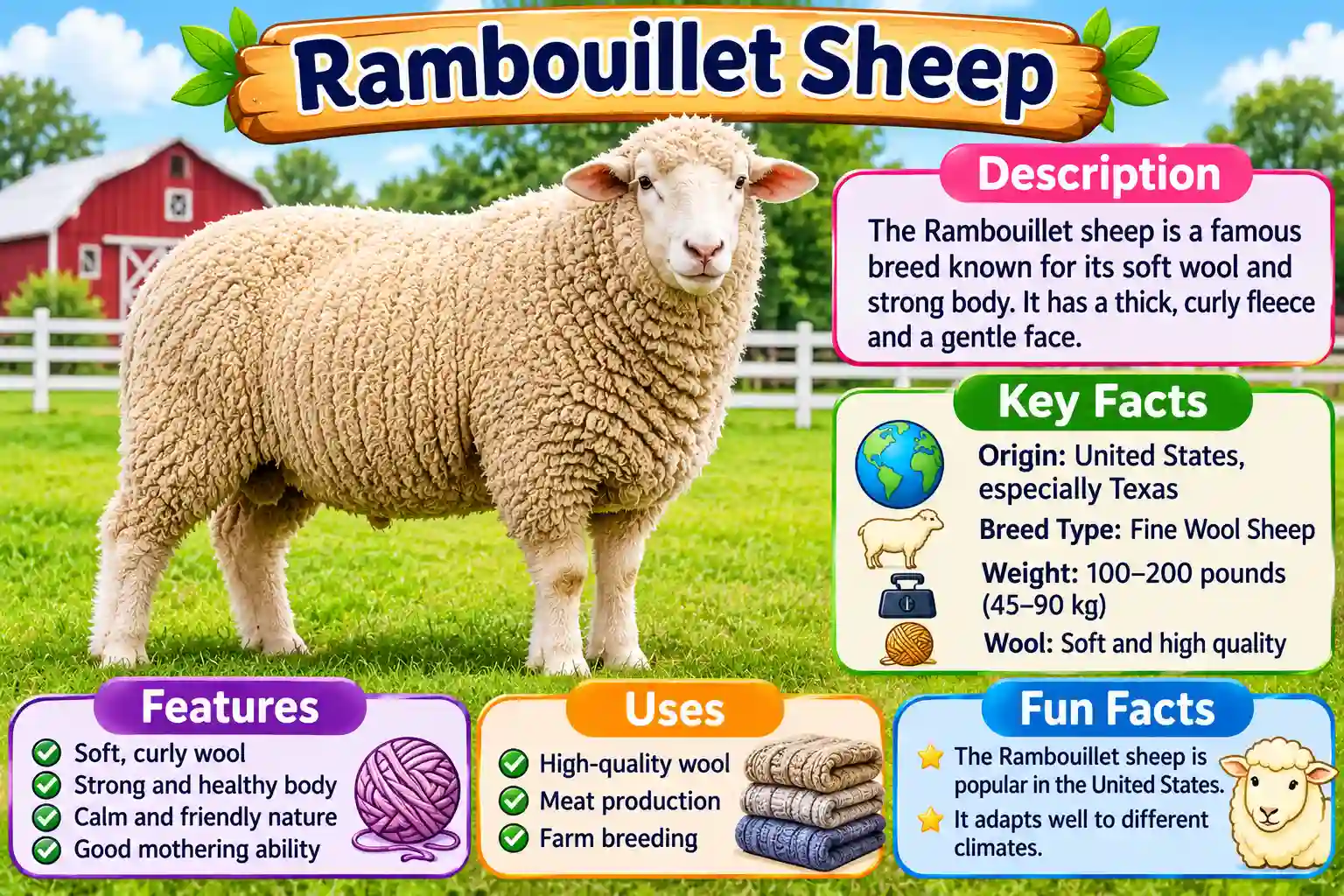
The Rambouillet sheep description helps us learn about a popular sheep breed. These sheep are large, strong, and known for their soft wool. Farmers raise them for wool and meat.
Rambouillet sheep have a long history. They came from Spanish Merino sheep and were raised in France many years ago. Later, they became popular in the United States and other countries.
Their wool is one of their best features. It is soft, warm, and has small natural waves. These waves are called crimps. The wool is used to make sweaters, socks, scarves, blankets, and yarn.
Rambouillet sheep also have strong bodies and good farming qualities. They can graze on open land and like to stay close to other sheep. Female sheep can be good mothers, while male sheep are often used for breeding.
This guide covers the history, size, weight, color, wool, food, behavior, breeding, health, and care of Rambouillet sheep. It also explains their uses, price, and differences from other sheep breeds.
What Are Rambouillet Sheep?

Rambouillet sheep are a breed of farm sheep known for their fine wool and large bodies. They are also called French Merino or American Merino.
Their family history comes from Spanish Merino sheep. These sheep were famous for their soft and fine wool.
Rambouillet sheep are raised for two main things: wool and meat. This is why they are called a dual-purpose breed.
Their large bodies provide meat, while their thick fleece provides soft wool. Farmers also like them because they can live in many types of grazing areas.
These sheep are social animals. They like to stay with other sheep and often move together. This natural habit is called flocking instinct.
Farmers may also use Rambouillet rams to improve the wool and body size of other sheep.
Rambouillet Sheep History and Origin
The history of Rambouillet sheep began with Spanish Merino sheep. Spain was once famous for its fine wool. Many farmers raised Merino sheep because they produced soft and valuable fleece.
For many years, Spain placed limits on the sale of Merino sheep to other countries. These rules helped protect the Spanish wool trade.
In 1786, Spain sent a group of Merino sheep to France. The group included 318 ewes, 41 rams, and 7 wethers. A wether is a male sheep that has been castrated.
The sheep were taken to a royal farm near Rambouillet, France. This farm was linked to King Louis XVI.
French breeders raised these sheep and worked to improve their wool and body size. Over time, the sheep became known as Rambouillet sheep.
The royal farm was called the Bergerie Royale. It later became known as the Bergerie Nationale.
The breed kept the fine wool of Spanish Merino sheep. However, it developed its own body shape and farming qualities.
How Rambouillet Sheep Reached the United States
Rambouillet sheep later became popular in the United States. American farmers wanted sheep that could produce fine wool and live on large farms.
During the 1800s, more Rambouillet sheep were brought to the United States. They became popular in western areas where farmers had large grazing lands.
These sheep were useful because they could walk over wide pastures and produce good wool. Their large bodies also made them useful for meat.
The American Rambouillet Sheep Breeders Association was formed in 1889. This group helped protect the breed and keep records of good sheep.
It also helped set rules for the breed. These rules explain the body shape, wool, and other features of a good Rambouillet sheep.
Why Is the Breed Called Rambouillet?
The breed gets its name from Rambouillet, a town in France.
Spanish Merino sheep were taken to this area in 1786. French breeders raised and improved them there.
Over time, the sheep became known by the name of the town. Today, Rambouillet is a well-known name in the wool and sheep farming world.
Rambouillet Sheep Physical Description
The Rambouillet sheep physical description includes a large body, strong legs, a wide back, and thick wool.
These features help the sheep walk, graze, and live on different types of farms.
Most Rambouillet sheep have white faces and white fleece. Their faces usually have little wool around the eyes. This helps them see clearly.
Their wool covers much of the body. It grows close together and helps protect the sheep from cold weather.
Common physical features include:
- A large and strong body
- A wide chest
- A strong back
- A deep body
- Strong legs and feet
- A white or cream-white face
- Thick white wool
- Fine and soft wool fibers
- A strong body frame
A healthy Rambouillet sheep should have strong legs and good body shape. It should walk without pain and have clean, healthy wool.
Rambouillet Sheep Size
Rambouillet sheep are a large breed. Their size makes them useful for both wool and meat.
Adult rams are usually larger than adult ewes. Rams have a bigger body and more weight. Ewes are often smaller but still have a strong body.
A lamb is much smaller than an adult sheep. It grows as it gets milk, grass, and other food.
The final size of a sheep depends on:
- Age
- Food
- Health
- Family line
- Living conditions
Farmers should look at more than size when choosing a sheep. They should also check its health, feet, teeth, wool, and movement.
Rambouillet Sheep Weight
Rambouillet sheep weight depends on age, sex, food, and family line.
Rams are usually heavier than ewes. The table below gives a general weight guide.
| Sheep type | General adult weight |
| Ram | 200–300 pounds |
| Ewe | 140–200 pounds |
Some breed records show higher weights for mature ewes. This means the weight can change from one flock to another.
A healthy sheep should not be too thin or too fat. Farmers can check its body to see if it has enough muscle and body cover.
Rams may lose some weight during the breeding season because they move around more. Pregnant and nursing ewes also need good food to stay healthy.
Rambouillet Sheep Color
The most common Rambouillet sheep color is white. Their faces and legs are also usually white.
Their fleece may be white or cream-white. White wool is useful because it can be dyed into many colors.
Wool workers use white fleece to make yarn, clothes, blankets, and other products.
Some sheep may have small color changes. However, white fleece is the main color linked with this breed.
Farmers who want registered Rambouillet sheep should check the breed rules before buying.
Rambouillet Sheep Head, Face, and Ears

The head is an important part of a Rambouillet sheep’s body.
Their face is usually white and clear around the eyes. The eyes should be bright and healthy.
Their ears are often medium in size. They should be clean and free from wounds.
The nose and nostrils should also be clear. A sheep with trouble breathing may need help from a vet.
Farmers should check the mouth and teeth too. Healthy teeth help sheep bite and chew grass.
Old sheep may have worn or missing teeth. This can make eating harder.
Rambouillet Sheep Body and Legs
Rambouillet sheep have a strong body that helps them walk and graze.Sheep need strong feet to walk across grass, soil, and rough land.
Farmers should check the hooves often. Hooves are the hard parts at the bottom of sheep feet.
Long or damaged hooves can cause pain. They can also make walking difficult.
Clean and dry ground helps lower the risk of foot problems.
Rambouillet Sheep Male and Female Features
Male and female Rambouillet sheep have some clear differences.
The adult male is called a ram. The adult female is called an ewe.
Rambouillet Rams
Rams are usually larger and heavier than ewes. They have strong bodies and are often used for breeding.
Some Rambouillet rams have horns. Other rams are polled, which means they do not grow horns.
A good breeding ram should have:
- Strong legs
- Healthy feet
- Good body shape
- Healthy teeth
- Good wool
- A healthy body
Farmers should also check the ram’s family history. This helps them choose animals with useful traits.
Rambouillet Ewes
Ewes are adult female sheep. They are raised for wool, lambs, and breeding.
Rambouillet ewes can be good mothers. They care for their lambs and feed them with milk.
Ewes are generally polled. They usually have thick wool and strong bodies.
Pregnant and nursing ewes need good food and clean water.
Rambouillet Sheep Wool
Rambouillet sheep wool is one of the main reasons farmers raise this breed.
Their wool is fine, soft, thick, and warm. It grows close together and covers much of the sheep’s body.
This thick coat helps protect sheep from cold weather.
Rambouillet wool is used to make:
- Sweaters
- Socks
- Scarves
- Blankets
- Hats
- Soft clothes
- Wool yarn
- Knitting items
- Weaving products
The wool can be used by home workers and large clothing companies.
What Makes Rambouillet Wool Special?
Rambouillet wool has many useful features.
Fine fibers: The wool fibers are thin. This helps make the wool feel soft.
Natural waves: The wool has small waves called crimps. They help the wool feel full and springy.
Warmth: Wool can hold warm air between its fibers. This helps keep the body warm.
Soft feel: Fine Rambouillet wool can feel smooth against the skin.
Good strength: Healthy wool fibers can be strong and useful for many products.
Stretch: The wool can stretch and return toward its normal shape.
Full feel: Rambouillet wool can hold space and feel thick. This is called loft.
Good mixing: The wool can be mixed with other fibers to make different types of yarn.
These features make Rambouillet wool useful for many products.
Rambouillet Sheep Wool Micron Count
A micron is a tiny unit used to measure how thick a wool fiber is.
A lower micron number means the fiber is thinner. A higher number means the fiber is thicker.
Rambouillet wool is often reported at around 18.5 to 24.5 microns. The exact number can change from one sheep to another.
Fine wool is often used to make soft clothes. Thicker wool may be used for other products.
Micron count is important to wool farmers and buyers. It helps them understand the quality of the wool.
Farmers can test wool samples to learn more about fiber thickness. These tests can help them choose good sheep for breeding.
Rambouillet Sheep Wool Staple Length
Staple length means the length of a wool fiber.
Rambouillet wool often has a staple length of about 2 to 4 inches. The length can change with the sheep and its family line.
Staple length is important because it can affect how wool is used.
Longer fibers may work well for some types of yarn. Shorter fibers may be used for other products.
Good food and healthy skin help support normal wool growth. Farmers should also shear sheep at the right time.
Rambouillet Wool Crimp, Softness, and Stretch
Crimp means the natural waves in wool fibers. Rambouillet wool often has clear and even waves.
These waves help wool hold air. This can make the wool feel soft, full, and warm.
Stretch means the wool can move and then return toward its first shape.
Softness depends on how thin the wool fibers are. Fine Rambouillet wool can feel gentle against the skin.
Loft means the wool can feel full and hold air. This can help make warm clothes and blankets.
These features make Rambouillet wool useful for many types of clothing.
Rambouillet Sheep Wool Grease
Wool grease is a natural oil found on sheep fleece. It is also called lanolin.
This oil helps protect the wool and skin. It can make fresh wool feel oily before washing.
Raw wool may also contain dirt, sweat, and small pieces of plants.
Wool workers wash the fleece to remove much of this material. This washing process is called scouring.
The amount of grease can change from one sheep to another.
Rambouillet Sheep Fleece Weight and Clean Wool Yield

Fleece weight means the weight of wool removed from a sheep.
A mature Rambouillet ewe may produce around 8 to 18 pounds of raw fleece. The amount depends on the sheep’s size and family line.
Raw fleece is not the same as clean wool. Fresh fleece contains grease, dirt, and other material.
Clean wool yield tells us how much wool remains after washing.
Rambouillet wool may have a clean yield of around 35% to 55%. The final amount can change with the fleece.
For example, a fleece that weighs 10 pounds before washing will weigh less after cleaning.
Farmers and wool buyers should keep raw fleece weight and clean wool weight separate.
Rambouillet Sheep Bradford Count
Bradford count is an older way to describe wool fineness.
A higher Bradford count usually means finer wool. A lower count usually means thicker wool.
Rambouillet wool is often placed in the fine-wool group. The exact count can change from one fleece to another.
Micron testing gives a more direct way to measure how thick wool fibers are.
Both methods can help wool buyers understand the type of wool they are buying.
What Are Rambouillet Sheep Used For?
Rambouillet sheep are mainly used for wool and meat. They can also be used for breeding and farm work.
Fine Wool Production
Their soft wool is used for clothes, yarn, scarves, and blankets.
Wool workers can spin the fleece by hand or use machines. The yarn can then be used for knitting and weaving.
Meat Production
Rambouillet sheep have large bodies. Their lambs can be raised for meat.
Good food and health care help lambs grow well.
Breeding
Rambouillet rams are used in some breeding plans. They can pass useful wool and body traits to their lambs.
Grazing
Rambouillet sheep can graze on open land. They often move together and can be useful on large farms.
Rambouillet Sheep Temperament
Rambouillet sheep usually have a calm and social nature. They like to stay close to other sheep.
They often move and graze as a group. This is called flocking instinct.
Their behavior can change with age, health, and how people treat them.
A sheep that feels afraid may run away. Gentle handling can help sheep feel safer.
Farmers should avoid shouting, hitting, or chasing sheep without a reason. Calm movement helps lower stress.
Are Rambouillet Sheep Friendly?
Rambouillet sheep can get used to people when they receive gentle care.
Some sheep may come close to farmers during feeding time. However, they are farm animals, not pets like dogs or cats.
Rams may be harder to handle during the breeding season. Farmers should always use safe methods when working with adult rams.
Rambouillet Sheep Flocking Instinct
Flocking instinct means sheep like to stay together.
Rambouillet sheep often graze and move as a group. One sheep may follow another when the flock moves to a new field.
This behavior can help farmers move their sheep from one pasture to another.
Sheep may also feel safer when they stay close to other sheep.
However, this habit does not protect them from every danger. Farmers still need good fences and safe shelters.
Rambouillet Sheep Grazing Habits
Rambouillet sheep are plant-eating animals. They eat grass and other plants found in pastures.
They can use many types of grazing land when enough safe food is available.
Farmers should make sure the pasture has enough grass for the whole flock.
If too many sheep stay in one field for too long, they may eat the grass faster than it can grow again.
Farmers can move sheep between fields. This gives the grass time to grow back. This method is called rotational grazing.
Good grazing plans help protect the land and provide food for the sheep.
What Do Rambouillet Sheep Eat?
Rambouillet sheep eat plants. Their main food is grass and pasture plants.
Their diet may include:
- Fresh grass
- Hay
- Clover
- Safe pasture plants
- Sheep mineral mix
- Clean drinking water
- Extra feed when needed
The right food depends on the sheep’s age, weight, and health.
Food for Lambs
Young lambs first drink milk from their mothers.
The first milk is called colostrum. It gives newborn lambs important nutrients and early protection.
As lambs grow, they begin to eat grass and other suitable feed.
Farmers should make sure lambs have clean water and safe food. They should also watch for slow growth or signs of illness.
Food for Pregnant Ewes
Pregnant ewes need enough food for their own bodies and their growing lambs.
Their food needs may increase during the last part of pregnancy.
Farmers should ask a vet or sheep expert for help with the right feeding plan.
Food for Nursing Ewes
Nursing ewes need extra energy to make milk for their lambs.
They need good food and clean water. Poor feeding may cause a ewe to lose weight and make less milk.
Rambouillet Sheep Climate Adaptability

Rambouillet sheep can live in different types of grazing areas. They are often raised on dry land and open farms.
Their thick wool helps protect them from cold weather. Their strong bodies also help them move across large pastures.
However, they still need care in very hot, cold, or wet weather.
Rambouillet Sheep in Hot Weather
Hot weather can make sheep feel uncomfortable.
Farmers should give them:
- Shade
- Fresh water
- Good airflow
- A cool place to rest
Sheep should not be forced to walk long distances during the hottest part of the day.
Fast breathing, weakness, and unusual behavior may be signs of heat stress.
Rambouillet Sheep in Cold Weather
Their thick wool gives them some protection from cold weather.
Even so, they need a dry place to rest. Wet wool and strong cold winds can cause problems.
Young lambs and weak sheep may need extra care during very cold weather.
Rambouillet Sheep in Dry Areas
Rambouillet sheep can be useful on dry grazing land when enough food and water are available.
They can move across wide pastures and stay close to their flock.
Farmers should not keep more sheep than their land can feed.
Rambouillet Sheep Breeding
Rambouillet sheep are used in breeding plans because they can pass useful traits to their lambs.
Farmers may choose breeding sheep based on:
- Wool quality
- Body size
- Good health
- Strong legs
- Good growth
- Mothering ability
A good breeding plan should have a clear goal.
For example, a farmer may want sheep with softer wool or faster-growing lambs.
Choosing a Rambouillet Ram

A breeding ram should be healthy and strong.
Farmers should check its legs, feet, teeth, body shape, and wool.
They should also ask about its family history and breeding record.
A ram should not be chosen only because it is large. Good health and body shape are also important.
Choosing Rambouillet Ewes
Good breeding ewes should have healthy bodies and strong feet.
Farmers should check their teeth and udder. A healthy ewe should be able to eat well and feed her lambs.
Ewes that have raised healthy lambs may be useful in a breeding flock.
Out-of-Season Breeding
Some Rambouillet sheep can breed during a longer part of the year than some other breeds.
This may give farmers more choices when planning lamb births.
Out-of-season breeding needs careful planning. Farmers must think about food, health, weather, and lamb care.
An experienced sheep breeder or vet can help make a safe plan.
Rambouillet Sheep Lambing and Pregnancy
Lambing is the process of giving birth to lambs.
A sheep is usually pregnant for about five months. The exact time can change a little.
Pregnant Rambouillet ewes need good food, clean water, and a safe place to rest.
Farmers should prepare a clean area before the lambs are born.
Signs That a Ewe May Be Ready to Give Birth
A ewe may show some changes before giving birth.
These signs may include:
- Restlessness
- Moving away from the flock
- A larger udder
- Changes in belly shape
- Looking for a quiet place
- Scraping the ground
Not every ewe shows all these signs.
Caring for Newborn Lambs
Newborn lambs need care soon after birth.
They should drink their mother’s first milk, called colostrum. This milk is very important for their early health.
Farmers should check that the lamb can stand and drink.
They should also make sure the mother accepts the lamb.
If a lamb is weak or cannot drink, the farmer should contact a vet.
Rambouillet Sheep Mothering Qualities
Rambouillet ewes can be good mothers.
A good ewe stays close to her lamb and allows it to drink milk.
Her milk gives the lamb energy and helps it grow.
Farmers should watch the mother and lamb after birth. They should check that the lamb gets enough milk and stays warm.
Some ewes may need extra help, so regular checks are important.
Rambouillet Sheep Crossbreeding
Crossbreeding means mating sheep from two different breeds.
Farmers may use Rambouillet sheep to improve wool quality, body size, and other useful traits.
Rambouillet sheep have helped develop other sheep breeds.
For example, the Columbia sheep breed was developed in the United States using Rambouillet and Lincoln sheep.
Crossbreeding can be useful when farmers have a clear goal. They may want lambs with good wool and strong bodies.
Farmers should choose healthy animals and keep records of the parents and lambs.
Rambouillet Sheep and Wool Processing
Rambouillet wool needs proper care after shearing.
The wool is removed from the sheep and prepared for use. The main steps include shearing, sorting, washing, carding, and spinning.
Shearing
Shearing means cutting the wool from a sheep.
Many wool sheep are shorn about once a year. The best time depends on the weather and farm needs.
A trained person should do the work. Careful shearing helps protect the sheep’s skin.
Sorting
After shearing, the wool is sorted by quality.
Wool from different parts of the body may have different lengths and conditions.
Clean and strong wool is often kept separate from dirty or damaged wool.
Scouring
Scouring means washing raw wool.
This step removes much of the dirt, grease, and sweat from the fleece.
The wool is dried before the next step.
Carding
Carding means opening and arranging wool fibers.
This makes the wool easier to spin into yarn.
Spinning
Spinning turns wool fibers into yarn.
Yarn can be made by hand or with machines. It can then be used for clothes and other products.
Dyeing
Dyeing means adding color to wool or yarn.
White Rambouillet wool is useful because it can be dyed into many colors.
Felting
Felting is a way of joining wool fibers together.
It can be used to make bags, hats, mats, and other items.
Woolen and Worsted Spinning
Wool can be spun in different ways.
Woolen spinning makes yarn that is often soft, full, and warm. The fibers are arranged in a way that can hold more air.
Worsted spinning makes smoother and more even yarn. It uses fibers that are lined up more closely.
The best method depends on the wool and the product being made.
Rambouillet Sheep Farming
These sheep can graze on open land and have strong bodies. However, a good farm still needs careful planning.
Farmers should think about land, food, water, fences, shelter, and health care.
Land and Pasture
Sheep need enough land to graze.
The amount of land depends on the number of sheep, grass growth, weather, and soil.
A good pasture should have safe plants and enough food.
Farmers can move sheep between fields to give the grass time to grow again.
Shelter
Sheep need a safe and dry place to rest.
A shelter can protect them from heavy rain, strong wind, and very hot or cold weather.
The shelter should have fresh air and enough space.
A clean resting area can help lower the risk of some health problems.
Fencing
Good fencing helps keep sheep in the right area.
It can also help protect them from danger.
Farmers should check fences often for holes or broken parts.
The type of fence depends on the land and local animals that may harm sheep.
Clean Water
Sheep need clean water every day.
They may need more water during hot weather and while feeding their lambs.
Farmers should clean water containers often.
Flock Records
Farmers should keep simple records for each sheep.
These records may include:
- Animal tag number
- Date of birth
- Parent details
- Health checks
- Vaccines
- Weight
- Shearing date
- Wool weight
- Lambing history
- Breeding details
Good records help farmers make better choices.
Rambouillet Sheep Health and Care

Rambouillet sheep are strong animals, but they can still become sick.
Good care helps lower the risk of many health problems.
Farmers should check their sheep often. They should look for changes in eating, walking, breathing, and behavior.
Common health problems can include foot issues, worms, skin problems, and poor body weight.
Foot Care
Sheep need healthy feet to walk and graze.
Long or damaged hooves can cause pain.
Farmers should check hooves often. They may need trimming when the hooves grow too long.
Wet and dirty ground can increase the risk of foot problems.
Worm and Parasite Control
Worms can live inside sheep and affect their health.
They may cause weight loss, weakness, and poor growth.
Other small pests can cause skin problems and damage the wool.
Farmers should work with a vet to make a safe plan to control these pests.
Skin and Wool Care
Healthy skin helps sheep grow healthy wool.
Farmers should check the fleece for dirt, wounds, and skin problems.
Shearing also makes it easier to check the skin.
A sheep with itching, hair loss, or unusual marks may need help from a vet.
Vaccines
Vaccines help protect sheep from some diseases.
The right vaccine plan depends on the area and local health risks.
A vet can tell farmers which vaccines their sheep need.
Body Condition
Farmers should check if their sheep are too thin or too fat.
Poor body weight may be linked to food problems, worms, illness, or bad teeth.
Good food and regular health checks can help sheep stay healthy.
Rambouillet Sheep and Predator Protection
Sheep can be at risk from wild animals and other predators.
Rambouillet sheep often stay close to their flock. This can help them stay together when they feel afraid.
However, staying in a group does not fully protect them.
Farmers can use strong fences, safe night shelters, and regular checks.
In some areas, trained guard animals may also help protect the flock.
The best plan depends on the local area and the animals that may harm sheep.
Rambouillet Sheep Lifespan
The life of a Rambouillet sheep depends on its family line, food, health, and care.
Some sheep may live for many years when they receive good care.
However, their useful time on a farm may be shorter than their full life.
Older sheep may have worn teeth, weak legs, or trouble keeping a healthy body weight.
Good food, clean water, hoof care, and health checks can help them stay healthy.
Rambouillet Sheep Advantages
Rambouillet sheep have many useful features.
Fine wool: Their wool is soft and useful for making clothes and yarn.
Large body: Their size makes them useful for wool and meat.
Strong animals: They can live in many grazing areas with proper care.
Group behavior: They often stay close to other sheep.
Breeding value: Rams can pass useful traits to their lambs.
Good mothers: Ewes can care for their lambs.
Many wool uses: Their fleece can be used for clothes, blankets, and crafts.
Rambouillet Sheep Disadvantages
Rambouillet sheep also need regular care.
Regular shearing: Their wool must be cut at the right time.
Wool cleaning: Raw fleece needs washing before many uses.
Health care: They need hoof checks and care for worms and other pests.
Feeding costs: Farmers must provide enough food, especially to pregnant and nursing ewes.
Safe shelter: They need a dry place to rest.
Changing wool prices: Wool prices can rise or fall.
Breeding costs: Good breeding animals may cost more.
These points do not make the breed a bad choice. They simply show that farmers need a good plan.
Rambouillet Sheep for Sale
People looking for Rambouillet sheep for sale can contact sheep breeders, livestock farms, and breed groups.
Some sellers offer young lambs, adult ewes, breeding rams, and registered sheep.
Before buying, farmers should learn about the animal’s age, health, and family line.
A healthy sheep should have:
- Clear eyes
- Strong feet
- Good movement
- A healthy body
- Clean wool
- No clear signs of illness
Buyers should also ask about vaccines and past health care.
If a sheep is sold as a registered Rambouillet, ask for its papers and parent records.
Rambouillet Sheep Price
The Rambouillet sheep price depends on many things. There is no single price for every sheep.
The price may depend on:
- Age
- Sex
- Body weight
- Health
- Wool quality
- Family line
- Registration
- Breeding history
- Location
- Local demand
A breeding ram may cost more than an ordinary sheep. A registered animal with a good family line may also have a higher price.
Prices can change from one country and area to another. Buyers should compare local sellers before buying.
What to Check Before Buying Rambouillet Sheep
Before buying, check the sheep carefully.
Look at its eyes, teeth, feet, and body. Ask about its food, health care, and vaccines.
If you are buying an ewe, ask if she has had lambs before.
If you are buying a ram, ask about its family line and breeding history.
Do not buy a sheep only because it is large or has thick wool. Good health is just as important.
Are Rambouillet Sheep Good for Beginners?
Rambouillet sheep can be a good choice for beginners who have enough land, time, and money.
New farmers should learn about sheep care before buying a flock.
They should know how to feed sheep, provide shelter, check their health, and arrange shearing.
Starting with a small flock can help new farmers learn step by step.
It is also helpful to speak with an experienced sheep farmer or vet.
Rambouillet Sheep Farming Costs and Profit

Rambouillet sheep farming may provide money from wool, lambs, meat, and breeding animals.
However, profit is not certain. Farmers must compare the money they spend with the money they earn.
Main Farming Costs
Common costs include:
- Buying sheep
- Building fences
- Making a shelter
- Buying food
- Providing clean water
- Vet visits
- Vaccines and medicine
- Shearing
- Transport
- Farm tools
- Worker costs
The total cost depends on the size of the flock and the local market.
Ways Farmers Can Earn Money
Farmers may earn money by selling:
- Raw wool
- Clean wool
- Young lambs
- Breeding rams
- Breeding ewes
- Adult sheep for meat
The price of wool depends on its quality, cleanliness, and local demand.
How to Improve Farm Results
Farmers can improve their results by keeping healthy sheep and good records.
They should choose breeding animals with care and give the flock enough food and water.
They should also protect their pasture and avoid keeping too many sheep on a small area.
A simple farm plan can help farmers understand their costs before they start.
Rambouillet Sheep Breed Standards
Breed standards explain the features of a good sheep of a certain breed.
The American Rambouillet Sheep Breeders Association helps protect and support the breed.
A good Rambouillet sheep should have a strong body, healthy legs, and thick wool.
Its fleece is usually white or cream-white.
Some rams have horns, while others do not grow horns.
Breed rules help farmers choose sheep for breeding and shows.
People who want registered Rambouillet sheep should check the latest rules of the breed group.
Important Wool Terms in Simple Words
People who work with Rambouillet wool use some special words.
Here are their simple meanings:
- Fleece: The wool that grows on a sheep.
- Shearing: Cutting wool from a sheep.
- Micron: A tiny unit used to measure wool thickness.
- Staple length: The length of a wool fiber.
- Crimp: The natural waves in wool.
- Wool grease: The natural oil in raw wool.
- Lanolin: Another name for natural wool grease.
- Fleece weight: The weight of wool removed from a sheep.
- Clean wool yield: The wool left after washing.
- Bradford count: A way to describe wool fineness.
- Carding: Opening and arranging wool fibers.
- Spinning: Turning wool fibers into yarn.
- Felting: Joining wool fibers to make a firm material.
These words are useful for farmers, wool buyers, and people who make wool products.
How to Choose Good Rambouillet Breeding Sheep
Choosing healthy breeding sheep is important for a strong flock.
Farmers should check the animal’s body, wool, feet, and health.
A good breeding sheep should have:
- Strong legs and feet
- A healthy mouth
- Good body shape
- Clean and thick wool
- Normal movement
- A healthy body weight
Farmers should also learn about the animal’s parents.
A breeding ram should be strong and healthy. A breeding ewe should have a healthy udder and good mothering skills.
Farmers should keep records of each sheep. This helps them know which animals pass good traits to their lambs.
How to Care for Rambouillet Lambs
Young lambs need special care during their first weeks.
After birth, a lamb should drink its mother’s first milk. This milk is called colostrum and is important for early health.
The lamb should have a warm and dry place to rest.
Farmers should check that the lamb can stand, walk, and drink milk.
As it grows, the lamb will begin to eat grass and other food.
Clean water should always be available.
Farmers should watch for weakness, poor feeding, loose stools, or slow growth. A sick lamb may need quick help from a vet.
Good care can help lambs grow into healthy adult sheep.
How Often Should Rambouillet Sheep Be Shorn?
Shearing means removing wool from a sheep.
Many wool sheep are shorn about once a year. The right time depends on the weather and farm conditions.
Farmers should choose a time when the sheep will not face very cold weather without shelter.
A trained person should do the shearing. This helps protect the sheep’s skin.
After shearing, sheep may need extra care. They should have a safe place away from heavy rain, strong wind, and very hot sun.
Is Rambouillet Wool Good for Clothing?
Yes, Rambouillet wool is useful for clothing.
Its fine fibers can make soft yarn and fabric. It can be used for:
- Sweaters
- Scarves
- Socks
- Hats
- Blankets
- Other soft clothes
The wool can also be mixed with other fibers. This can change the feel and strength of the final yarn.
The best use depends on the wool’s thickness, length, and condition.
Can Rambouillet Sheep Live on Pasture?
Yes, Rambouillet sheep can live on pasture when enough safe food and water are available.
They are often raised on open grazing land. Their habit of staying together can help farmers move them between fields.
However, pasture may not provide all the food every sheep needs.
Pregnant ewes, nursing mothers, growing lambs, and breeding rams may need extra feed.
Farmers should check the grass and provide more food when needed.
Are Rambouillet Sheep Easy to Raise?
Rambouillet sheep can be easy to manage when farmers understand their needs.
They need food, clean water, safe fences, shelter, shearing, and health checks.
Their group behavior can help farmers manage them. Their wool and large bodies also make them useful farm animals.
Still, raising sheep takes time and planning. New farmers should learn about the breed before buying animals.
Why Are Rambouillet Sheep Important to Sheep Farming?

Rambouillet sheep have played an important part in fine-wool farming.
They brought many Spanish Merino wool traits into French and American sheep farming.
Their wool is used for clothing, yarn, and other products.
They have also been used to improve other sheep breeds through breeding.
Their large bodies, fine wool, and ability to graze on open land make them useful for farmers who want both wool and meat.
Rambouillet sheep show how careful breeding can create animals with useful farming traits.
FAQs
A Rambouillet sheep is a fine-wool breed developed in France from Spanish Merino sheep. Farmers raise it for wool and meat.
Rambouillet sheep were developed in France. Their history is linked to Spanish Merino sheep brought to France in 1786.
They are famous for their soft wool, large bodies, and ability to live on different types of grazing land.
Most Rambouillet sheep have white or cream-white wool and a white face.
Adult rams may weigh around 200 to 300 pounds. Ewes may weigh around 140 to 200 pounds. Their weight can change with age and breeding line.
Rambouillet sheep are a large breed. Rams are usually bigger than ewes.
They are used for fine wool, meat, breeding, and farm production.
Yes. Rambouillet wool is known for its fine fibers and soft feel.
Rambouillet wool is often reported at around 18.5 to 24.5 microns. The exact number can change from one fleece to another.
Rambouillet wool often has a staple length of about 2 to 4 inches.
A mature ewe may produce around 8 to 18 pounds of raw fleece. The amount of clean wool is lower after washing.
Crimp means the natural waves in wool fibers. These waves help wool feel full and warm.
Some Rambouillet rams have horns, while others do not. Ewes are generally without horns.
Yes. They are raised for both wool and meat.
They can be a good choice for beginners who have enough land, food, water, shelter, and time to care for them.
They eat grass, hay, clover, and other safe plants. They also need clean water.
Yes, with proper care. Farmers should provide shade, fresh water, and good airflow.
They are known as strong and hardy sheep. However, they still need good food, shelter, and health care.
Rambouillet sheep came from Spanish Merino sheep. Both have fine wool, but Rambouillet sheep were also bred for a larger body.
Rambouillet sheep are known for fine wool and meat. Southdown sheep are mainly raised for meat.
A sheep is usually pregnant for about five months.
A ewe may give birth to one or more lambs. The number depends on her age, health, and family line.
Many Rambouillet sheep are shorn about once a year. The best time depends on the weather and farm needs.
Yes. Farmers can cross Rambouillet sheep with other breeds to pass useful wool and body traits to their lambs.
You can look for them through sheep breeders, livestock farms, and breed groups.
Price depends on age, sex, weight, health, wool quality, family line, and local demand.
Yes. Its fine fibers can be used to make soft yarn for knitting and weaving.
It is a group that supports Rambouillet sheep breeders and helps protect the breed.
A dual-purpose sheep is raised for two main products. Rambouillet sheep are raised for wool and meat.
Lanolin is the natural oil found in raw sheep wool. It is removed during the wool-washing process.
Its thin fibers can feel soft against the skin. Its natural waves also help make warm and full wool products.
Final Thoughts
The Rambouillet sheep description shows why this breed is popular with farmers and wool workers.
These sheep have a long history that began with Spanish Merino sheep and continued in France near the town of Rambouillet.
They are known for their large bodies, strong legs, white fleece, and soft wool. Their wool has natural waves that help it feel warm and full.
Farmers raise Rambouillet sheep for wool, meat, and breeding. They can graze on open land and often stay close to their flock.
Like all sheep, they need good food, clean water, safe shelter, and regular health care. Farmers should also plan breeding and pasture use with care.
With good care, Rambouillet sheep can be a useful part of a wool and meat farm.

Sarah Whitman writes job descriptions and role guides that explain duties, skills and requirements in a clear, organized way. She covers technical, office and everyday roles, so job seekers, students and hiring teams can quickly see what a position involves.