

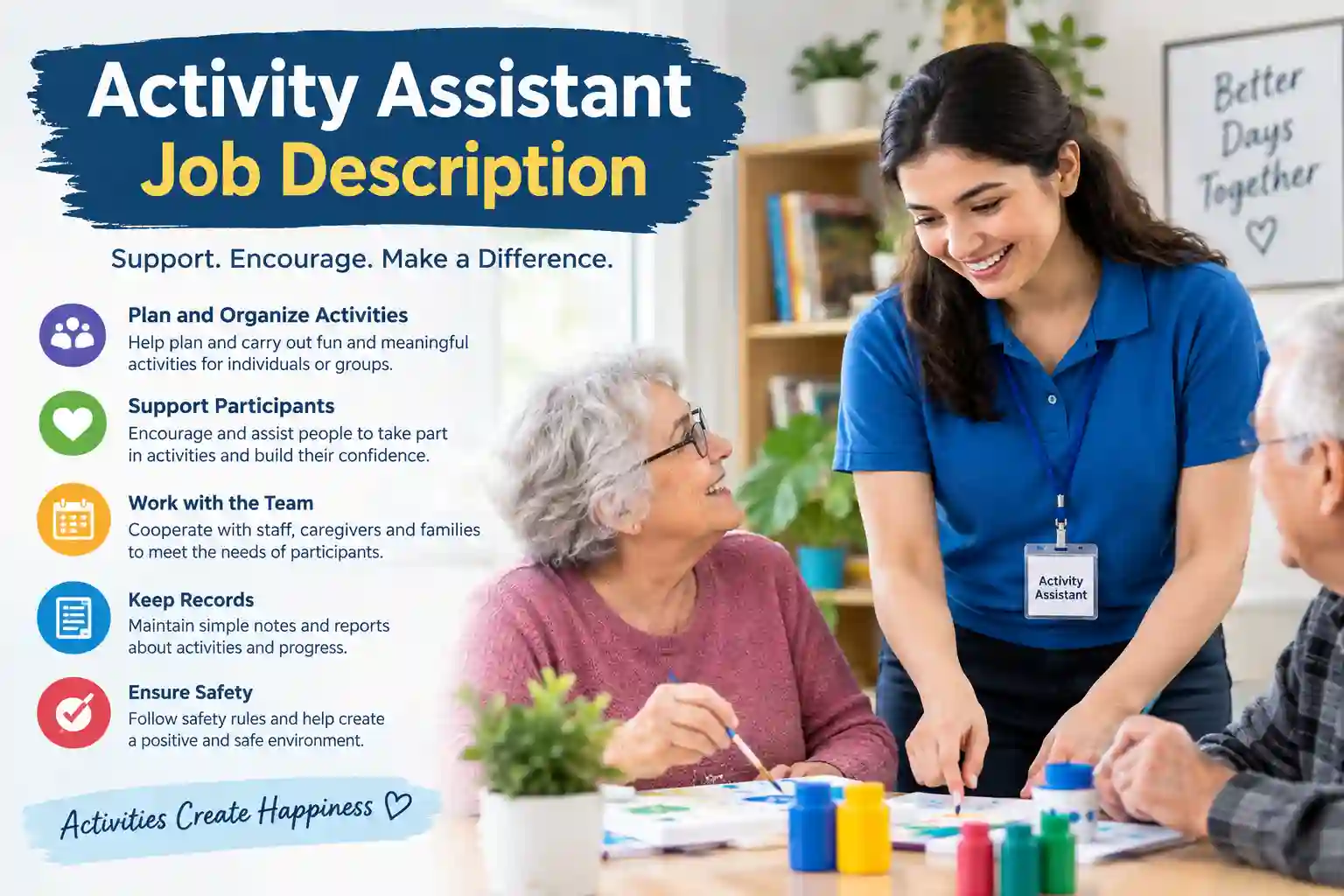
An activity assistant helps people enjoy their day through fun, safe, and meaningful activities. These workers may help older adults, children, patients, or other groups take part in games, arts and crafts, exercise, music, and social events.
An Activity Assistant Job Description explains the main duties, skills, education, and experience needed for this role. It also helps employers find the right person and helps job seekers prepare a strong resume.
Activity assistants can work in nursing homes, assisted living facilities, community centers, schools, summer camps, and other places. Their main goal is to keep people active, included, and connected with others.
What Is an Activity Assistant?
An activity assistant plans, prepares, and supports activities for people in a group or care setting. They may work under an activity coordinator, activity director, or another supervisor.
The job includes preparing activity materials, helping people join activities, keeping records, and making sure the activity area is safe.
For example, an activity assistant in a senior living facility may organize a music session, a board game, or an arts and crafts activity. In a summer camp, the same worker may help with group games, outdoor events, and creative projects.
The exact duties depend on the workplace and the needs of the people taking part.

Activity Assistant Job Description and Duties
The main duties of an activity assistant focus on planning, organizing, and supporting activities.
Common activity assistant duties and responsibilities include:
- Help plan daily, weekly, and monthly activities.
- Prepare activity schedules and event plans.
- Lead or support games, crafts, music, and group activities.
- Encourage people to take part in activities.
- Adjust activities to match different needs and abilities.
- Prepare rooms, tables, equipment, and supplies.
- Clean and organize activity areas after each event.
- Record attendance and participation.
- Listen to feedback from participants.
- Work with other staff members and volunteers.
- Help organize special events and group outings.
- Keep activity supplies organized.
- Follow safety rules and workplace policies.
- Report concerns to the supervisor.
- Help improve activities based on participant feedback.
An activity assistant may also help promote upcoming events through notices, flyers, newsletters, or other approved communication methods.
What Does an Activity Assistant Do Every Day?
The daily work of an activity assistant changes with the workplace. However, most days include preparation, communication, activity support, and recordkeeping.
At the start of a shift, the assistant may review the activity calendar and prepare the required materials. They may arrange chairs, check equipment, and make sure the activity space is ready.
During an activity, they explain the instructions, help participants, and encourage everyone to join in when they feel comfortable.
After the activity, they clean the area, put supplies away, record attendance, and share useful feedback with the team.
An activity assistant should stay organized, patient, and ready to change plans when needed.
Activities Assistant Job Description in a Nursing Home
An activities assistant in a nursing home helps residents enjoy their time and stay connected with others. Activities may support social contact, creativity, movement, and mental engagement.
Common duties in this setting include:
- Help prepare activities for nursing home residents.
- Plan games, music sessions, crafts, and social events.
- Encourage residents to join suitable activities.
- Adapt activities to match residents’ abilities and interests.
- Follow resident care plans and facility safety rules.
- Work with care staff to understand activity needs.
- Record attendance and report concerns.
- Help prepare birthday parties and seasonal events.
The assistant should respect each resident’s choices and comfort. Some residents may enjoy group activities, while others may prefer a quiet activity or one-to-one support.
Memory Care Activity Assistant Job Description
A memory care activity assistant supports people who have memory-related needs. The role requires patience, clear communication, and activities that are suitable for each person.
Duties may include preparing simple games, familiar music sessions, art activities, and small group events. The assistant may repeat instructions when needed and give participants enough time to respond.
Activities should follow the person’s care plan and the facility’s safety guidance. The assistant should work with trained care staff when an activity needs special support.
The goal is to provide a calm, respectful, and welcoming experience for every participant.
Activities for Nursing Home Residents
Activities can help nursing home residents enjoy their day and connect with other people. An activity assistant may help arrange different options based on residents’ interests and abilities.
Arts and Crafts
Residents may enjoy painting, coloring, drawing, paper crafts, or simple decoration projects. The assistant prepares materials and offers help when needed.
Music and Singing
Music sessions may include familiar songs, group singing, or listening to favorite music. These activities can create a shared and enjoyable experience.
Games and Puzzles
Board games, card games, word games, and simple puzzles give residents a chance to take part in an activity at their own pace.
Social Activities
Group conversations, themed events, birthday celebrations, and family activities can help residents spend time with others.
Gentle Movement Activities
Suitable seated movement sessions may help residents participate in light physical activity. These activities should follow the facility’s guidance and each resident’s abilities.
Seasonal Events
The assistant may help organize events for holidays, birthdays, and changes of season. Decorations, music, and simple group projects can make these events enjoyable.
How to Create an Activity Calendar for Seniors
An activity calendar helps staff, residents, and families understand what is planned. It also helps an activity assistant prepare materials and manage time.
A useful calendar may include daily games, weekly music sessions, craft activities, social gatherings, and special events.
When preparing a calendar, the assistant should:
- Consider residents’ interests and preferences.
- Include different types of activities.
- Allow enough time for each event.
- Check staff availability and room arrangements.
- Prepare the needed equipment and supplies.
- Make the calendar easy to read.
- Update the plan when changes are needed.
The calendar should be flexible. Activities may need to change because of participant needs, staff schedules, or other workplace requirements.
How to Increase Participation in Senior Activities
Some residents may not want to join every activity. An activity assistant should respect their choices and look for ways to make activities more welcoming.
Helpful approaches include asking residents what they enjoy, offering different activity options, and explaining events in simple language.
Small groups may suit some people better than large gatherings. Familiar music, favorite games, or personal interests may also encourage participation.
The assistant can ask for feedback and share useful suggestions with the activity coordinator. Participation should always be voluntary and suitable for the person.
Activity Supplies and Equipment
Activity supplies help staff prepare safe and enjoyable programs. The items needed depend on the activity and the workplace.
Common supplies may include:
- Paper, coloring pencils, markers, and paint.
- Craft paper, glue, and safe craft materials.
- Board games, cards, and puzzles.
- Music equipment approved by the facility.
- Tables, chairs, and storage containers.
- Calendars, attendance sheets, and activity forms.
- Supplies for decorations and special events.
An activity assistant may check inventory, store items properly, and tell the supervisor when supplies are running low. They should follow workplace rules when handling equipment and materials.
Group Activities That Build Social Connections
Group activities give people a chance to talk, share interests, and work together. An activity assistant may organize group activities such as:
- Group games and puzzles.
- Art and craft sessions.
- Music and singing.
- Book or story discussions.
- Simple team challenges.
- Themed celebrations.
- Group projects and shared decorations.
The assistant should explain instructions clearly and help create a welcoming space. Activities should allow people with different abilities and interests to participate when possible.
How to Evaluate an Activity Program
An activity program should meet the needs and interests of the people taking part. Activity assistants can help the team understand what works well and what may need to change.
They may record attendance, listen to feedback, and observe whether participants seem interested and comfortable.
Useful questions include:
- Did participants understand the activity?
- Were the supplies and space suitable?
- Could people with different needs take part?
- Did the activity finish as planned?
- What feedback did participants share?
- What could be improved next time?
The assistant can share these observations with the activity coordinator or supervisor. Changes should follow workplace policies and participant needs.

Activity Assistant Skills and Qualifications
An activity assistant needs a mix of people skills and practical skills. Employers often look for someone who is caring, organized, creative, and able to work with a team.
Communication Skills
The assistant should explain activities clearly, listen to participants, and share important information with coworkers.
Creativity
Creative thinking helps the assistant plan activities that match different interests, ages, and abilities.
Organization and Time Management
The assistant may need to prepare materials, follow a schedule, manage supplies, and complete records. Good organization helps activities run smoothly.
Patience and Compassion
Some participants may need extra time, encouragement, or support. Patience helps the assistant respond in a respectful way.
Teamwork
Activity assistants often work with coordinators, care staff, teachers, volunteers, or other employees. They should share information and follow instructions.
Safety Awareness
The assistant should understand workplace safety rules and report problems to the right person.
Basic Computer Skills
Some jobs require the assistant to use computers for schedules, attendance records, emails, or activity reports.
Physical Ability
Some duties may involve setting up rooms, carrying supplies, or helping prepare activity areas. The exact requirements depend on the job.
Activity Assistant Requirements and Education
Requirements vary by employer and workplace. Some entry-level positions require a high school diploma or equivalent, while others may ask for related experience or additional training.
Helpful qualifications may include:
- High school diploma or equivalent.
- Experience in recreation, care, education, or customer service.
- Strong communication and organization skills.
- Knowledge of suitable games and recreational activities.
- CPR or First Aid training when required or preferred.
- Ability to follow safety rules and workplace procedures.
- Required background checks for the role.
Some employers may prefer training in recreation, activity programming, or a related field. Applicants should read the job advertisement carefully because each employer may have different requirements.
Activity Assistant Jobs With No Experience
Some activity assistant jobs are suitable for people who are new to the field. Employers may focus on communication, patience, creativity, reliability, and a willingness to learn.
Volunteer work, school activities, community events, or helping organize group programs can provide useful experience. These activities may help applicants show that they can work with people and support events.
When applying for an entry-level role, highlight transferable skills such as teamwork, organization, customer service, and communication. Do not claim experience or qualifications that you do not have.
Where Do Activity Assistants Work?
Activity assistants work in different settings, depending on the needs of the people they support.
Nursing Homes and Senior Living Facilities
They help arrange activities for residents and support social interaction.
Assisted Living Facilities
They may organize games, group events, crafts, and other suitable activities for residents.
Hospitals and Rehabilitation Facilities
They may help support recreational programs under workplace guidance.
Schools and Daycare Centers
They may assist with games, creative projects, and group activities for children.
Community Centers
They may help arrange classes, social events, recreation programs, and community gatherings.
Summer Camps and Recreation Programs
They may support group games, planned events, creative activities, and outings.
The exact duties depend on the employer, the participants, and the type of program.
Activity Assistant Job Description Template for Employers

Employers can use the following sample as a starting point and change it to match their workplace.
Job Title: Activity Assistant
Job Summary
We are looking for a caring and organized activity assistant to help plan and support activities for our participants. The successful candidate will help prepare activity areas, encourage participation, maintain records, and work with other staff members to provide a safe and welcoming environment.
Main Responsibilities
- Help plan and organize activities and events.
- Prepare activity schedules, materials, and equipment.
- Support group and individual activities.
- Encourage participation and respect individual preferences.
- Keep activity spaces clean and organized.
- Record attendance and share feedback.
- Monitor supplies and report when items need replacing.
- Work with team members and follow workplace policies.
Required Skills
- Good communication and people skills.
- Organization and time management.
- Creativity and patience.
- Ability to work as part of a team.
- Willingness to follow safety procedures.
- Relevant education or experience as required by the employer.
Education and Experience
The education and experience requirements should match the needs of the workplace. Related experience may be helpful, while training or certifications may be required for some positions.
Activity Assistant Job Description for Resume
A resume should explain the skills and experience that match the advertised position. Use clear language and focus on duties you have actually performed.
Activity Assistant Resume Summary Example
“Caring and organized candidate with strong communication, teamwork, and planning skills. Interested in helping people take part in safe and enjoyable activities. Able to prepare materials, support group events, and follow instructions.”
This example is suitable for a person who has these skills but does not yet have direct activity assistant experience. Change the wording to reflect your real background.
Activity Assistant Duties for Resume
If these duties match your experience, you may include statements such as:
- Assisted with planning and preparing group activities.
- Organized supplies and prepared activity spaces.
- Supported games, crafts, and social events.
- Encouraged participation and communicated with team members.
- Maintained activity schedules and attendance records.
- Followed safety rules and workplace instructions.
Use past-tense action words for previous jobs. For a current role, present-tense action words may be suitable.
Activity Assistant Skills for Resume
Relevant skills may include communication, organization, time management, teamwork, creativity, patience, recordkeeping, and activity planning.
Choose the skills that genuinely match your abilities and the job advertisement.
Activity Assistant vs. Activities Aide vs. Activity Coordinator
These job titles can be similar, but the exact responsibilities depend on the employer.
An activity assistant usually helps prepare and run activities. An activities aide may perform similar support duties, especially in care settings.
An activity coordinator often has more responsibility for planning schedules, organizing programs, and coordinating staff or resources.
An activity director may oversee the wider activity program, staff, and program goals.
Always check the job description instead of assuming that every employer uses these titles in the same way.
Activity Assistant Salary
An activity assistant salary depends on the country, employer, workplace, experience, education, and job duties. Full-time and part-time roles may also offer different pay and benefits.
To understand the salary for a particular job, check current job advertisements in your area. Compare the hourly rate or annual salary, work schedule, required experience, and benefits.
Some employers may offer training or opportunities to move into coordinator or director roles. However, career growth depends on experience, qualifications, and available positions.
Activity Assistant Jobs Near Me
To find activity assistant jobs near you, search local job websites, employer career pages, hospitals, nursing homes, assisted living facilities, schools, and community centers.
Try relevant search phrases such as “activity assistant jobs near me,” “activities assistant jobs,” or “activity aide jobs.” You can also search by the name of your city.
Before applying, review the duties, location, work hours, pay, and required qualifications. Prepare a resume that matches the position and includes only accurate information about your skills and experience.

Activity Assistant Work Schedule
The work schedule depends on the workplace. Some activity assistants work regular daytime hours, while others may work evenings, weekends, or holidays.
Care facilities, camps, and recreation programs may schedule activities at different times. Some positions are full-time, while others are part-time or temporary.
Read the job advertisement or ask the employer about shift times, weekly hours, and weekend duties before accepting a position.
Activity Assistant Interview Questions
Employers may ask questions to understand how you work with people and organize activities.
Common questions include:
- Why do you want to become an activity assistant?
- What activities would you plan for a group?
- How would you encourage someone who does not want to join?
- How do you organize materials and schedules?
- How would you respond if an activity needed to change?
- How do you work with a team?
- What would you do if you noticed a safety concern?
Give honest answers and use examples from your work, studies, volunteering, or other relevant experience. If you are new to the field, explain how your existing skills could help you learn the role.
How to Become an Activity Assistant
Starting this career usually involves building relevant skills and finding an employer whose requirements match your background.
First, review job advertisements to learn which qualifications employers request. Next, develop communication, organization, teamwork, and activity-planning skills.
Related volunteering or work experience may help you understand how to support groups. Complete any required training or certifications listed by the employer.
Then prepare a clear resume, apply for suitable positions, and practice answering common interview questions.
Career Growth for Activity Assistants
With experience and suitable training, an activity assistant may apply for other roles in recreation, community programs, senior care, or activity planning.
Possible career paths include activities aide, activity coordinator, recreation assistant, activity director, or recreation program worker. Requirements vary by employer, so check the qualifications needed for each position.
Building strong communication skills, learning to organize programs, and gaining relevant experience can help prepare you for future opportunities.

Frequently Asked Questions
The main duty is to help plan, prepare, and support activities that meet participants’ interests and needs. The assistant may also organize supplies, record attendance, and follow safety procedures.
Important skills include communication, patience, creativity, teamwork, organization, time management, and safety awareness.
Not always. Some entry-level jobs accept applicants with little direct experience. Requirements depend on the employer, and related volunteering or work experience may be helpful.
An activity assistant helps residents take part in suitable games, crafts, music sessions, social events, and other activities. They may also prepare materials and record participation.
Some employers ask for a high school diploma or equivalent. Others may require related experience, training, certifications, or additional qualifications.
An activity assistant usually supports daily activities, while an activity coordinator may have greater responsibility for planning programs and organizing resources. Duties vary by workplace.
Include a clear summary, relevant skills, education, work experience, and duties that match the job. Make sure every claim is accurate.
Pay varies by location, experience, employer, and work schedule. Check current local job advertisements for reliable salary information.
They may work in nursing homes, assisted living facilities, hospitals, schools, daycare centers, community centers, summer camps, and recreation programs.
Yes. Some employers offer part-time, full-time, or temporary positions. The available schedule depends on the workplace.
Final Thoughts
An activity assistant helps people take part in enjoyable, useful, and meaningful activities. The job requires patience, communication, creativity, organization, and teamwork.
Understanding the activity assistant job description can help employers explain the role clearly and help job seekers prepare for applications and interviews. Before applying, check the employer’s duties, qualifications, schedule, and salary details so you know what the position requires.

Sarah Whitman writes job descriptions and role guides that explain duties, skills and requirements in a clear, organized way. She covers technical, office and everyday roles, so job seekers, students and hiring teams can quickly see what a position involves.